 Українська
 English
Inverters. General information
Manufacturing inverters and also converter equipment for renewable energy and standby power is one of NPP "VEL"'s priority areas.
NPP "VEL" manufactures the following variants inverters:
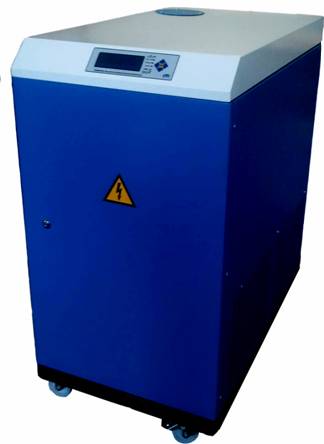
- Off-grid inverters are designed to supply loads from a stand-alone source of electricity, usually a battery bank.
The battery bank in turn can be charged from the public grid or from alternative energy sources, cogeneration plants, diesel generators or petrol generators…
Alternative sources of electricity may include wind turbines, solar panels (photovoltaic modules) and hydro generators (hydro turbines)… - Off-grid invertersmanufactured by NPP "VEL" are fitted with a built-in automatic transfer device, or ATS for short (abroad such devices are called Automatic Transfer Switch, ATS). Having an ATS inside the inverter makes it possible to switch the load automatically between inverter supply and mains supply. This is a very convenient feature for the user. In short, why it matters: when the battery bank is discharged, the control unit built into the inverter shuts the inverter down and uses the ATS to connect the load to the public grid. Once the battery is recharged, the control unit restarts the inverter automatically and transfers the load back to inverter supply.
- Off-grid invertersmanufactured by NPP "VEL" are fitted with a built-in high-speed static transfer switch (STS). The static switch transfers the load between inverter and mains in (0.01…0.02) s. Such a short transfer time is practically imperceptible to the load. The static switch is built from semiconductor or solid-state switching devices and has no mechanical moving parts subject to wear.
- Off-grid invertersmanufactured by NPP "VEL" are fitted with a built-in automatic bypass. The bypass is used when the battery bank supplying the inverter is completely disconnected or deeply discharged. In that case the load is connected automatically to the public grid, bypassing the inverter, by means of a contactor built into the inverter.
- Invertersmanufactured by NPP "VEL" can also be fitted with a mains with a charger for battery banks. An inverter fitted with a charger, STS and ATS is called by an uninterruptible power supply (UPS, Uninterruptible Power Supply for short). A UPS may be built as an on-line (double-conversion) or an off-line type. The mains charger works with various battery types and offers several operating modes, including equalisation and capacity-recovery modes.
- Inverter with mains with a charger, fitted with a dual-channel time switch saves more than 70% of electricity costs. This is achieved by using multi-tariff metering. The batteries are charged from the grid at night, on the cheaper night tariff. During peak and shoulder periods the inverter draws energy from the battery bank and supplies your site, so you do not pay for expensive electricity.
- Invertersmanufactured by NPP "VEL" can be fitted with with a battery charge controller from solar panels, with maximum power point tracking (MPPT), with a charge controller for wind turbines (wind turbine).
NPP VEL manufactures single-phase off-grid inverters rated 10 kVA and 16 kVA, and also three-phase off-grid inverters rated 30 kVA and 50 kVA. Connecting inverters in parallel raises the total to 100 kVA, 150 kVA and beyond.
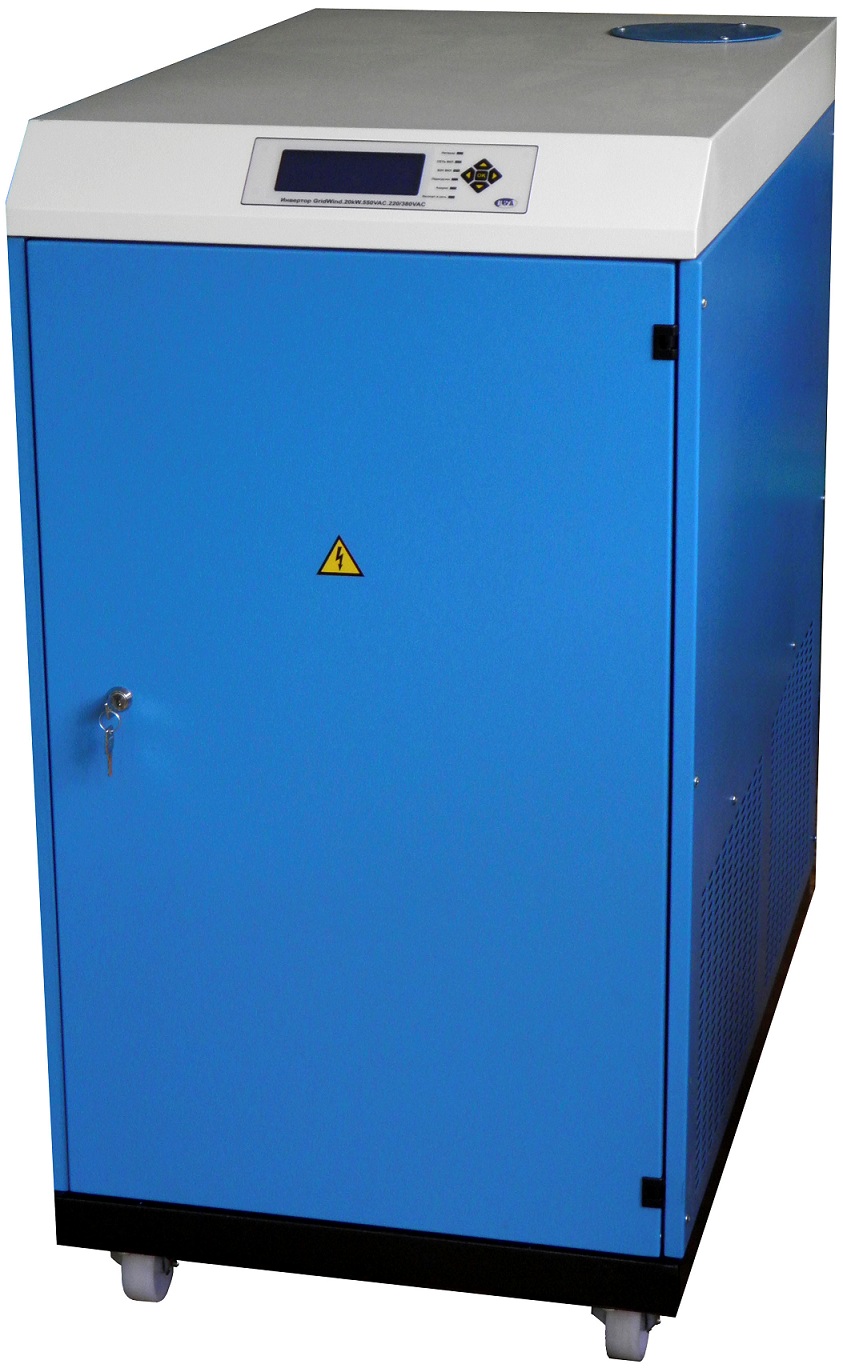
- This group of inverters is designed to feed electricity into the public grid or to export it.
- Grid-tie inverters do not need a battery bank. Grid-tie inverters are powered directly from the alternative energy source and export all the energy they generate to the public grid.
- Grid-tie inverters can operate from solar panels with maximum power point tracking (MPPT), and also with wind turbines (wind turbine).
- Hybrid wind-and-solar grid-tie inverters can also be built.
NPP VEL manufactures single-phase grid-tie inverters rated 10 kW and 16 kW, and also three-phase inverters rated 20 kW, 30 kW and 50 kW. Connecting inverters in parallel raises the total to 100 kW, 150 kW and beyond.